Data Engineering Roadmap: From SQL and Python to Modern Data Pipelines
A practical guide to building data pipelines, working with cloud platforms, and developing production-ready data systems
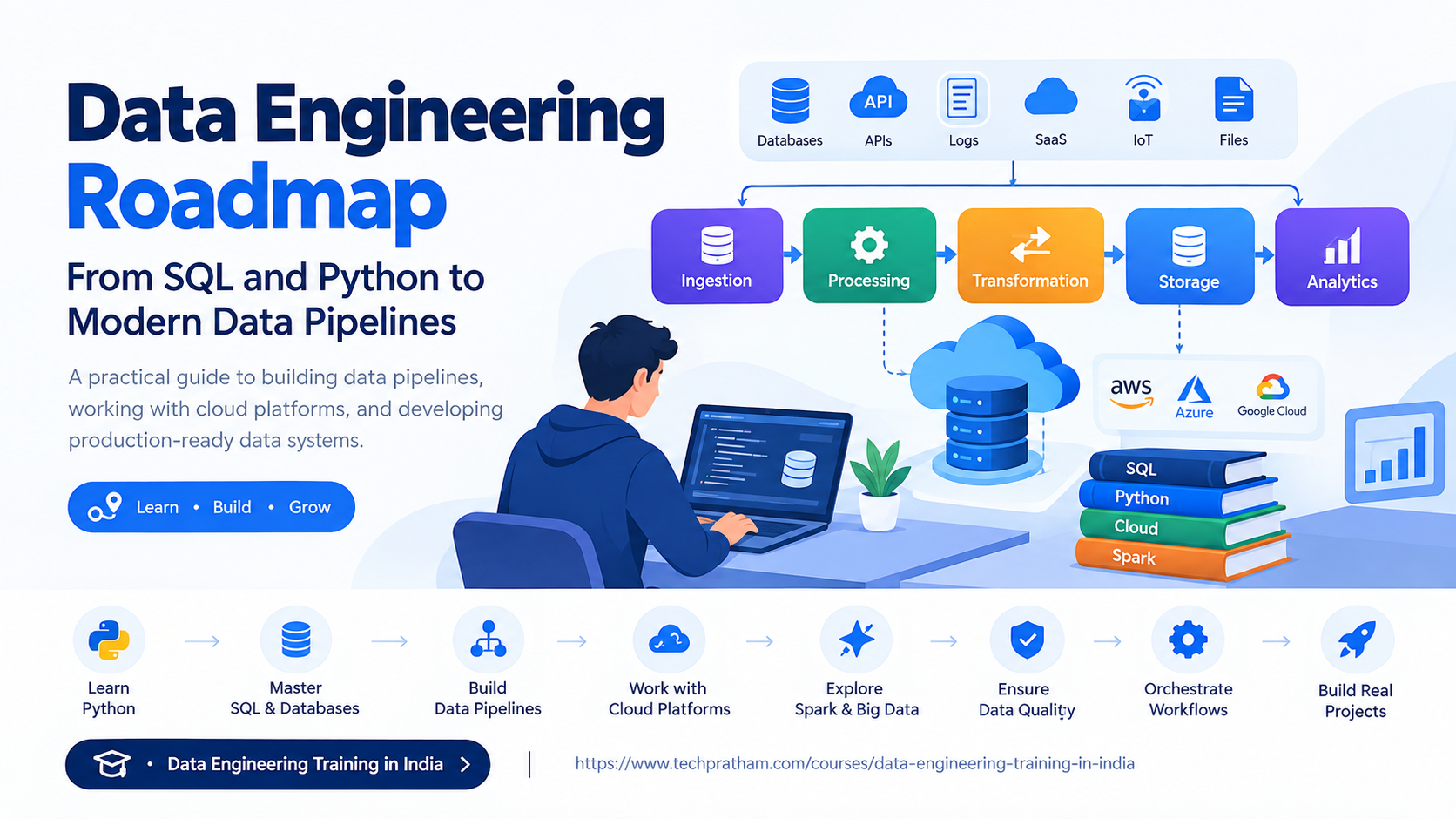
Modern applications generate enormous amounts of data through transactions, APIs, customer interactions, application logs, connected devices, and business operations.
But raw data is only the beginning.
Before analysts can build dashboards, data scientists can train machine learning models, or businesses can make informed decisions, data needs to be collected, processed, transformed, validated, and stored properly.
That is where data engineering becomes important.
For developers and technology professionals, learning data engineering is not simply about learning SQL or one cloud platform. It requires an understanding of databases, Python, data pipelines, ETL and ELT, data warehouses, distributed processing, cloud infrastructure, and data quality.
This guide explains a practical roadmap for building those skills.
What Does a Data Engineer Actually Do?
A data engineer designs and maintains systems that collect, process, transform, and deliver data for downstream use.
A typical data engineering workflow can look like:
Data Sources → Ingestion → Processing → Transformation → Storage → Analytics
Data can come from:
Relational databases
APIs
Application logs
SaaS applications
IoT devices
Streaming systems
Files and documents
The data engineer makes sure this information reaches the right destination in a reliable and usable form.
Production systems must also handle problems such as failed pipelines, duplicate records, missing data, schema changes, and increasing data volumes.
Start With SQL
SQL is one of the most important skills for anyone entering data engineering.
A beginner should become comfortable with:
SELECT and filtering
JOINs
GROUP BY and aggregations
Subqueries
Common table expressions
Window functions
Views
Indexes
Transactions
Query optimization
SQL is essential because many business applications continue to rely on relational databases.
However, knowing SQL is not only about writing queries. A data engineer should also understand how queries interact with databases and how inefficient queries can affect performance.
Learn Python for Data Engineering
Python is useful for building data pipelines, automation scripts, and data-processing applications.
Important areas include:
Functions and modules
File handling
Exception handling
APIs
JSON and CSV processing
Virtual environments
Logging
Testing
For example, a Python pipeline could retrieve data from an API, validate the response, transform the records, and load the results into a warehouse.
This makes Python a valuable complement to SQL.
Understand Databases
Data engineers need to understand how information is stored and accessed.
Start with relational databases and learn:
Tables
Primary keys
Foreign keys
Relationships
Normalization
Indexes
Transactions
Constraints
After that, explore analytical databases, data warehouses, and data lakes.
Understanding the difference between transactional and analytical workloads is especially important when designing data systems.
Learn ETL and ELT
ETL stands for Extract, Transform, and Load.
Data is extracted from a source, transformed, and then loaded into the target system.
ELT follows a different approach:
Extract → Load → Transform
Data is loaded into the destination first and transformed there.
Modern cloud data platforms have made ELT architectures increasingly common.
The important skill is understanding why a particular architecture is appropriate for a specific data problem, rather than simply memorizing the terminology.
Build Data Pipelines
Data pipelines are at the center of data engineering.
A pipeline might:
Extract data from an API.
Validate incoming records.
Clean inconsistent values.
Transform the data.
Load it into a warehouse.
Run quality checks.
Notify the team if something fails.
A production pipeline should be reliable, observable, and maintainable.
This is why data engineering involves much more than simply transferring data between systems.
Learn Data Warehousing
Data warehouses are designed primarily for analytical workloads.
Important concepts include:
Fact tables
Dimension tables
Star schemas
Snowflake schemas
Data marts
Slowly changing dimensions
Partitioning
Clustering
Incremental loading
You should also understand how analytical workloads differ from transactional workloads.
This knowledge helps data engineers design systems that support reporting and analytics efficiently.
Understand Data Lakes and Lakehouse Architecture
Data lakes can store large amounts of structured, semi-structured, and unstructured information.
Lakehouse architectures attempt to combine the flexibility of data lakes with capabilities traditionally associated with data warehouses.
These concepts are increasingly relevant when working with modern cloud data platforms.
Learn Distributed Data Processing
Large datasets can eventually become difficult to process efficiently on a single machine.
This is where distributed processing becomes important.
Apache Spark is one of the technologies commonly associated with large-scale data processing.
Important concepts include:
Distributed computation
Data partitioning
Parallel processing
Transformations
Aggregations
Shuffles
Fault tolerance
You do not need to begin with advanced distributed-systems theory.
Start by understanding why distributed processing is required and how frameworks such as Spark handle large datasets.
Learn Data Orchestration
Real-world data platforms may contain many interconnected tasks.
For example:
Extract → Validate → Transform → Load → Quality Check → Report
Someone needs to manage dependencies, scheduling, retries, and failures.
This is where workflow orchestration becomes useful.
Tools such as Apache Airflow can help data teams schedule and monitor data workflows.
Understanding DAGs, dependencies, scheduling, and retries is valuable for production data engineering.
Learn Cloud Data Engineering
Modern data platforms increasingly use cloud infrastructure.
Depending on the organization, you may encounter:
Amazon Web Services
Microsoft Azure
Google Cloud
You do not need to master every cloud platform at the beginning.
Choose one ecosystem and understand how it provides:
Object storage
Compute
Databases
Data warehouses
Networking
Identity and access management
Monitoring
Once the underlying concepts are clear, learning another cloud platform becomes easier.
Data Quality Is a Core Engineering Skill
A pipeline that runs successfully but produces incorrect data is not a successful pipeline.
Data engineers therefore need to implement quality checks.
These can include:
Missing-value checks
Duplicate detection
Schema validation
Data-type validation
Unexpected-value detection
Referential integrity
Record-count validation
Data freshness checks
Automated quality checks can prevent bad data from reaching dashboards, applications, and machine learning systems.
Learn Data Engineering Monitoring
Production pipelines need observability.
Useful monitoring information can include:
Pipeline execution status
Processing duration
Failure rates
Data volume
Data freshness
Task-level logs
Retry counts
Good monitoring helps teams identify not only that a pipeline failed, but also where and why it failed.
A Practical Data Engineering Learning Roadmap
A beginner does not need to learn every technology simultaneously.
A structured progression can look like this:
Stage 1: Learn Programming Fundamentals
Start with Python and basic software-development concepts.
Stage 2: Learn SQL and Databases
Become comfortable with SQL and relational database systems.
Stage 3: Learn Data Processing
Understand practical data transformation and processing techniques.
Stage 4: Learn ETL and ELT
Build pipelines that extract, transform, and load data.
Stage 5: Learn Data Warehousing
Understand analytical schemas, data marts, and warehouse architecture.
Stage 6: Learn Workflow Orchestration
Learn scheduling, dependencies, retries, and pipeline monitoring.
Stage 7: Learn Distributed Processing
Build foundational knowledge of Spark and large-scale data processing.
Stage 8: Learn Cloud Data Platforms
Choose a cloud ecosystem and build practical data solutions.
Stage 9: Learn Production Practices
Add testing, monitoring, security, documentation, and data-quality practices.
This progression creates a stronger foundation than learning disconnected tools without understanding how they fit together.
Projects Every Beginner Should Build
Projects are one of the best ways to turn theoretical knowledge into practical engineering skills.
Project 1: API to Data Warehouse Pipeline
Build a Python pipeline that retrieves data from an API, transforms it, and loads it into a database or warehouse.
Add validation and error handling to make the pipeline more realistic.
Project 2: E-commerce Data Pipeline
Create a pipeline for customer, order, and product data.
Build analytical tables and include data-quality checks.
Project 3: Batch Processing Pipeline
Build a scheduled pipeline using a workflow orchestration platform.
Add logging, retries, and failure notifications.
Project 4: Streaming Data Pipeline
Build a basic architecture that demonstrates how real-time events can move through a streaming data system.
These projects can become valuable portfolio pieces because they demonstrate complete workflows rather than isolated technical skills.
What Skills Do Data Engineers Need?
A strong data engineering skill set combines technical, engineering, and problem-solving abilities.
Technical Skills
SQL
Python
Databases
ETL and ELT
Data warehousing
Data pipelines
Distributed processing
Cloud platforms
Workflow orchestration
Engineering Skills
Testing
Version control
Documentation
Monitoring
Debugging
Security
Performance optimization
Problem-Solving Skills
Data engineers also need to understand the business requirements behind a data platform.
The objective is not necessarily to build the most complicated architecture.
The objective is to build a reliable system that delivers accurate data at the right time.
How to Choose Data Engineering Training
If you are considering Data Engineering Training in India, evaluate the curriculum based on practical engineering skills rather than simply counting the number of tools included.
A useful program should ideally cover:
SQL and databases
Python
ETL and ELT
Data pipelines
Data warehousing
Data lakes
Apache Spark
Workflow orchestration
Cloud data platforms
Data quality
Monitoring
Real-world projects
Hands-on projects are particularly valuable because data engineering is fundamentally about building and maintaining working systems.
For learners looking for a structured learning path, Data Engineering Training in India can provide a focused route from SQL and Python fundamentals toward pipelines, cloud platforms, distributed processing, and modern data architecture.
Data Engineering vs Data Science
Data engineering and data science work closely together but generally focus on different parts of the data lifecycle.
A data engineer primarily focuses on collecting, processing, storing, and delivering reliable data.
A data scientist typically uses that data for statistical analysis, experimentation, and machine learning.
A simplified workflow can look like:
Data Engineer → Data Platform → Data Scientist → Models and Insights
The boundaries can overlap in modern organizations, but understanding the distinction can help beginners choose an appropriate career direction.
What Does a Modern Data Engineer Need to Know?
The role continues to evolve alongside modern data platforms.
Data engineers may increasingly encounter:
Cloud-native architectures
Real-time data processing
Data lakes and lakehouses
Analytics engineering
Data observability
Infrastructure automation
Machine learning data pipelines
AI data infrastructure
The fundamentals remain important, but continuous learning is becoming an increasingly important part of the profession.
Final Thoughts
Data engineering is fundamentally about building reliable systems that turn raw information into usable data.
You do not need to learn every technology at once.
Start with SQL, Python, and databases, then progress toward pipelines, ETL and ELT, data warehouses, orchestration, distributed processing, and cloud platforms.
Most importantly, build projects that demonstrate how these components work together.
A strong data engineer is not simply someone who knows many tools. It is someone who can design reliable data workflows, maintain data quality, troubleshoot failures, and build systems that support real analytical and business requirements.
A structured Data Engineering Training in India roadmap combined with consistent hands-on projects can help build the foundation required for modern data engineering roles.