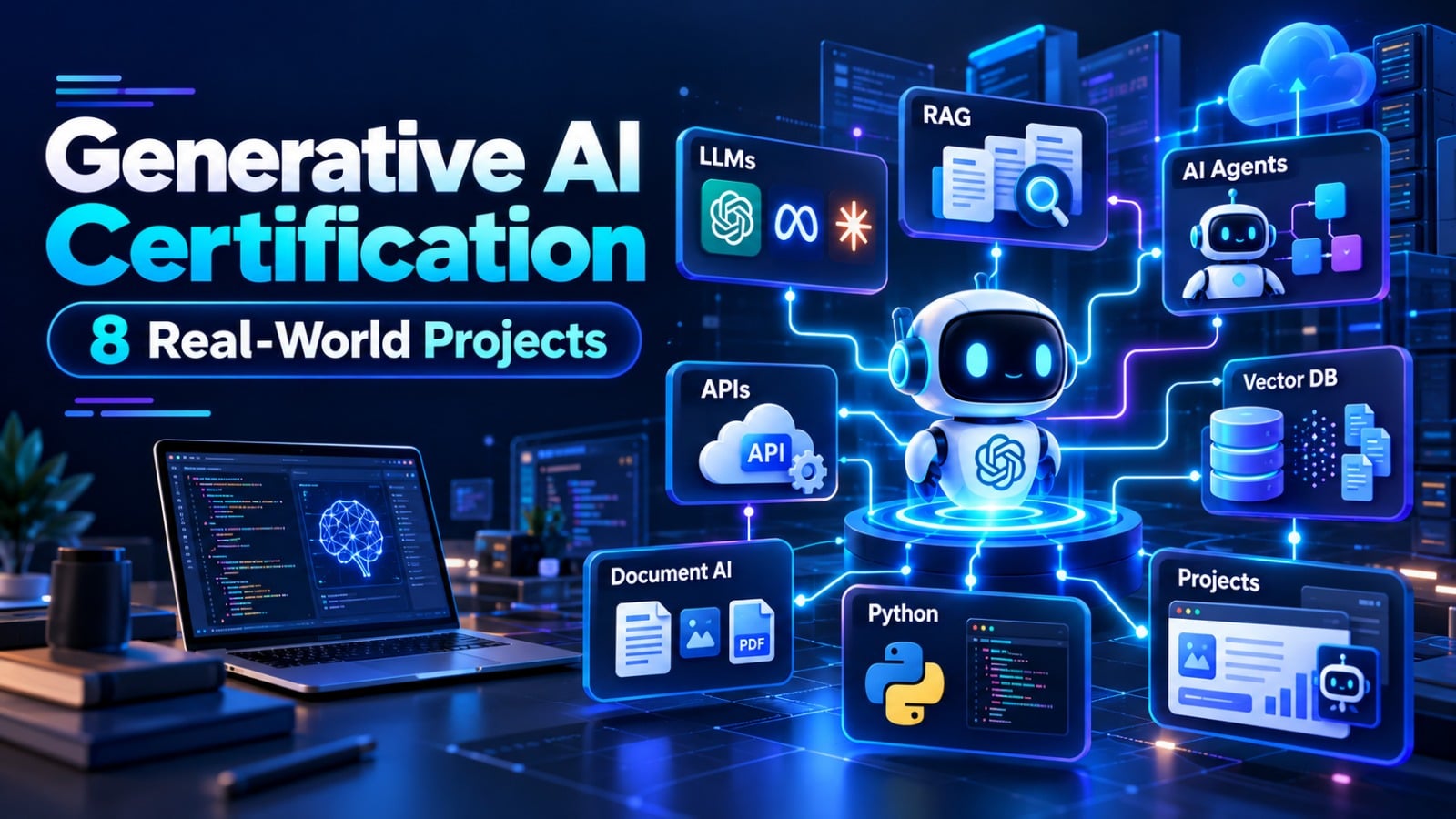
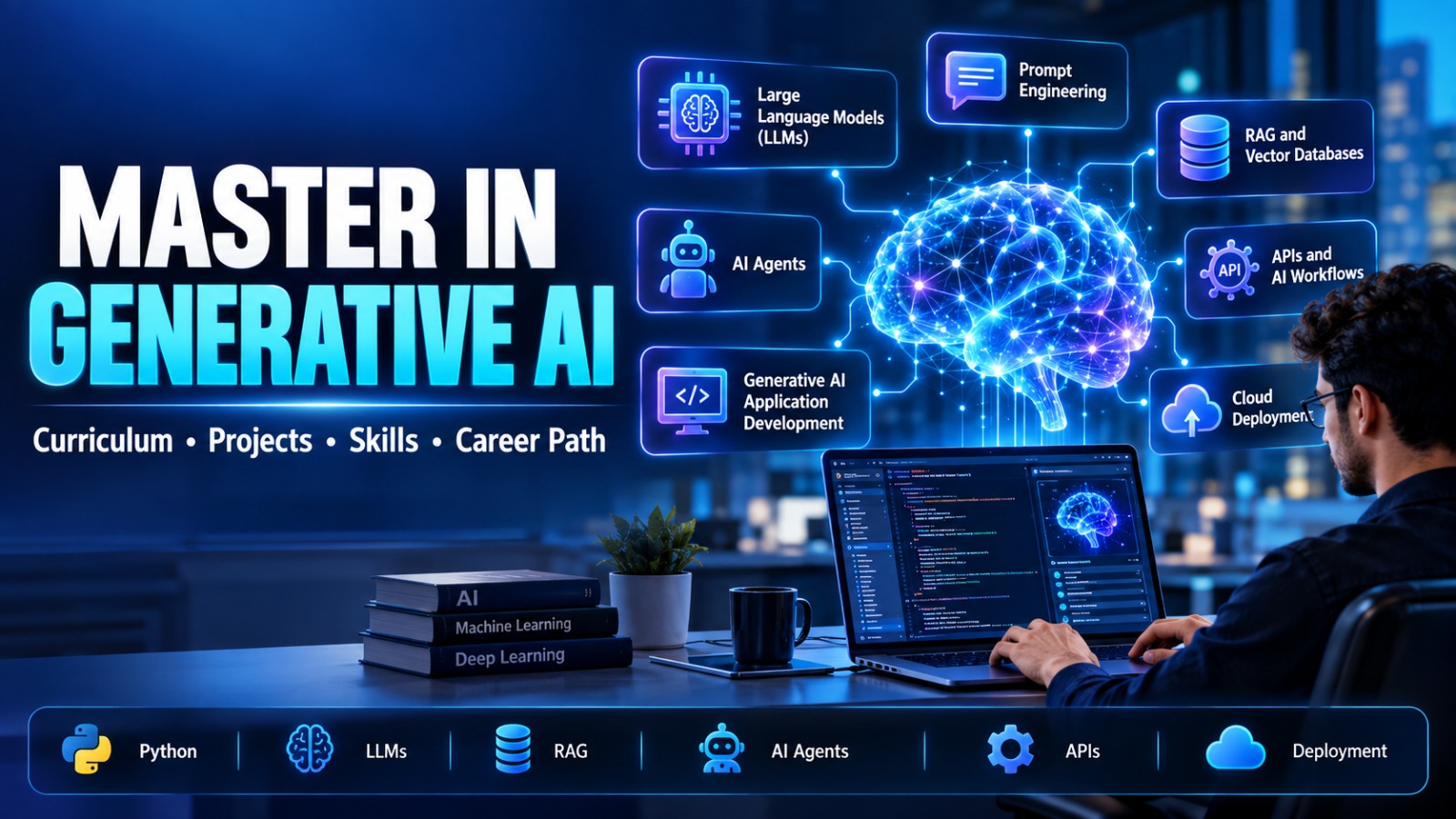
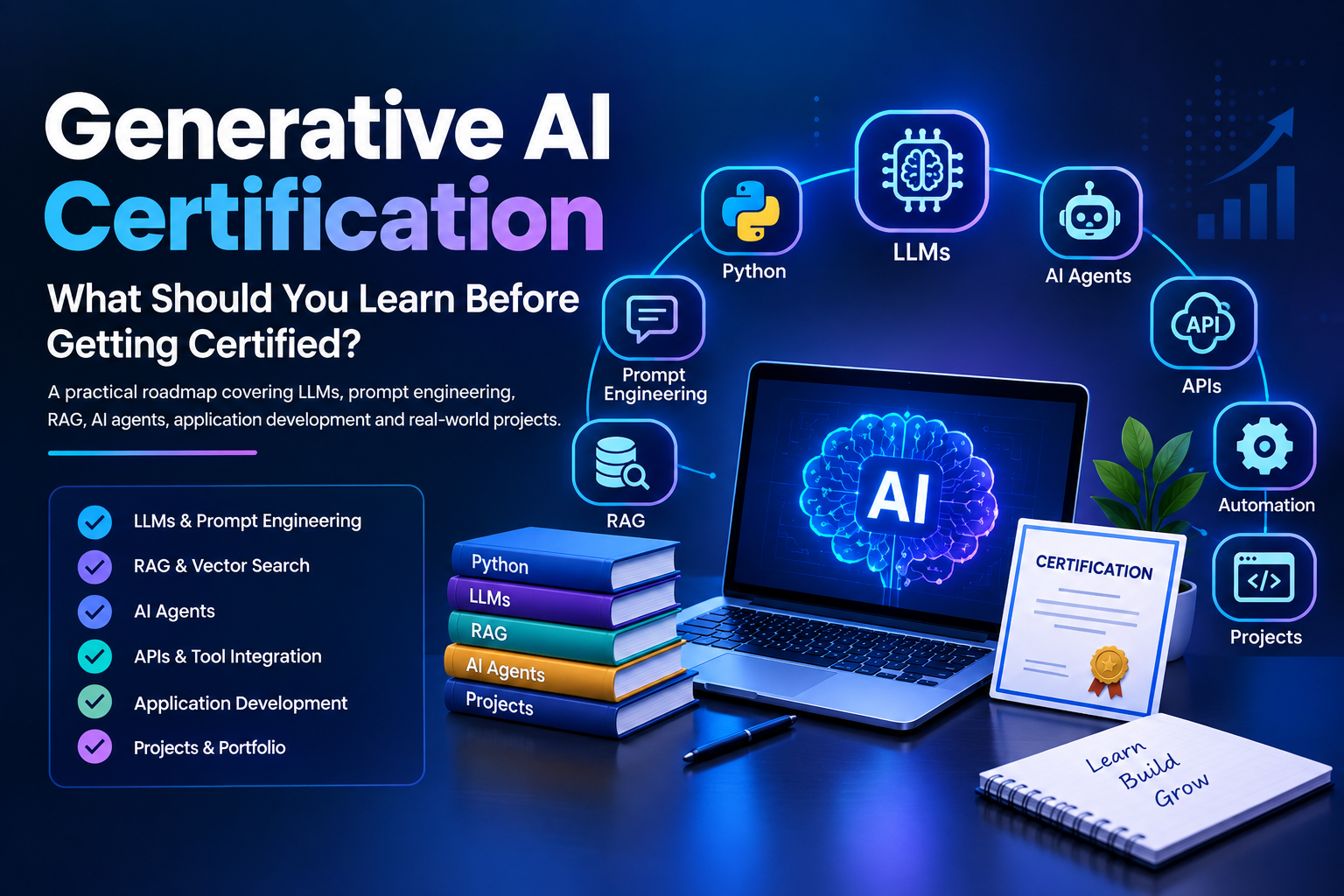
Generative AI Certification: What Should You Learn Before Getting Certified?
A practical roadmap covering LLMs, prompt engineering, RAG, AI agents, application development and real-world projects
Generative AI has moved quickly from an experimental technology to a practical development skill.
Today, developers and technology professionals can use large language models to build chatbots, document assistants, research tools, coding assistants, AI agents and automated business workflows.
But learning Generative AI is not simply about knowing how to write prompts.
If you are considering a Generative AI certification, the more important question is:
What should you actually learn before getting certified?
A strong learning path should take you from understanding large language models to building applications that can retrieve information, use tools, interact with APIs and solve practical problems.
This guide explains the core skills worth learning and how they fit together.
What Does Generative AI Certification Actually Mean?
A Generative AI certification can demonstrate structured learning or knowledge in areas related to generative artificial intelligence.
However, certifications can vary significantly.
Some focus on fundamentals and concepts, while others emphasize application development, cloud platforms, machine learning or specific AI technologies.
For developers, certification should ideally complement practical experience rather than replace it.
The strongest combination is:
Concepts + technical skills + projects + certification
This gives you both theoretical understanding and evidence that you can apply what you have learned.
Start With Generative AI Fundamentals
Before working with advanced AI applications, understand what Generative AI actually does.
Important concepts include:
Generative AI
Machine learning
Deep learning
Large language models
Natural language processing
Transformers
Tokens
Context windows
Model inference
AI model limitations
You do not necessarily need to understand every mathematical detail behind modern models.
However, you should understand the basic relationship between models, prompts, context, data and generated outputs.
This foundation makes advanced topics much easier to understand.
Learn How Large Language Models Work
Large language models, or LLMs, are central to many modern Generative AI applications.
A developer working with LLMs should understand concepts such as:
Tokens
Context
Embeddings
Transformer-based architectures
Model parameters
Inference
Temperature
Structured outputs
Hallucinations
Model limitations
The objective is not to train a massive model from scratch.
Instead, you should understand how to work with existing models effectively and how they fit into an application architecture.
For example, an application might use an LLM as one component while other components handle retrieval, databases, authentication, business logic and external tools.
Prompt Engineering Is Only the Beginning
Prompt engineering is an important Generative AI skill, but it should not be the end of your learning journey.
A simple prompt might ask a model to summarize a document.
A production application may need to:
Understand the user's request
Retrieve relevant information
Provide context to the model
Generate a structured response
Call an external tool
Validate the output
Handle errors
This is why modern Generative AI development involves much more than prompt writing.
You should learn how prompts work together with context, tools, data and application logic.
Learn Embeddings and Vector Search
One of the most useful concepts for building AI applications is the relationship between text and embeddings.
An embedding represents information in a numerical form that can be used for similarity-based retrieval.
This enables applications to search for information based on meaning rather than relying only on exact keyword matches.
A typical workflow might look like this:
Document → Chunking → Embeddings → Vector Database → Similarity Search → Retrieved Context → LLM
Understanding this workflow prepares you for one of the most important Generative AI application patterns: Retrieval-Augmented Generation.
Understand RAG
Retrieval-Augmented Generation, or RAG, allows an AI application to retrieve relevant external information before generating a response.
This can be useful when an application needs to work with information that is not contained in the model's original training data.
For example, a company could build a knowledge assistant that retrieves information from internal documentation before generating an answer.
A basic RAG pipeline may include:
Document ingestion
Text extraction
Chunking
Embedding generation
Vector storage
Retrieval
Context construction
LLM generation
Response evaluation
RAG is therefore an important topic for anyone interested in building practical Generative AI applications.
Learn AI Agents
The next step beyond basic LLM applications is understanding AI agents.
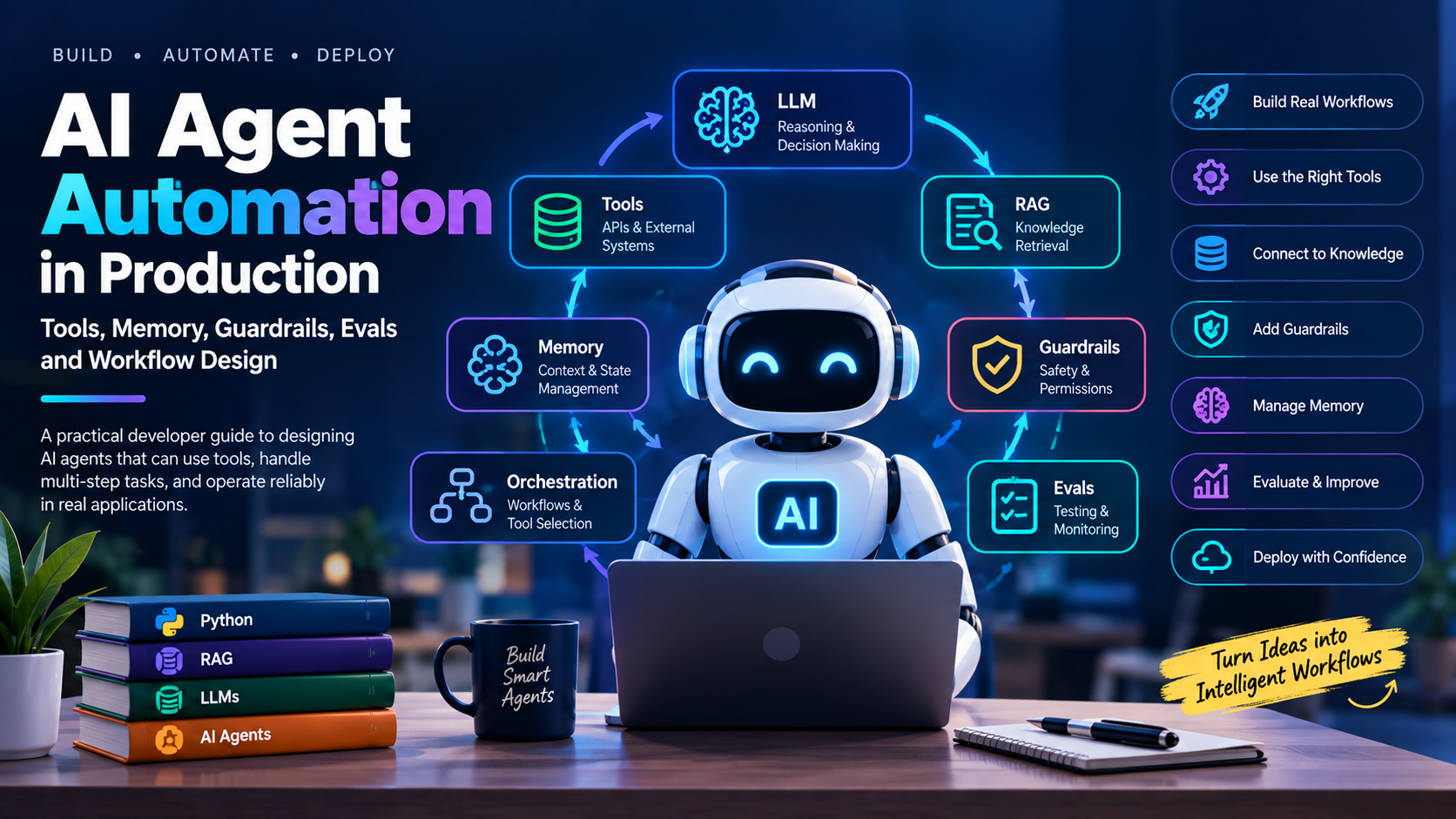
An AI agent can use a model together with tools, instructions, context and application logic to perform multi-step tasks.
For example, an agent could:
Receive a user request
Search a knowledge source
Call an API
Analyze information
Perform a calculation
Generate a response
Ask for human approval when necessary
This creates a more dynamic workflow than a traditional question-and-answer chatbot.
If you are preparing for a modern Generative AI career, understanding AI agents can be a valuable extension of your LLM knowledge.
Learn Tool Calling and APIs
Generative AI applications often need to interact with systems outside the model.
This is where APIs and tool calling become important.
You should understand:
REST APIs
HTTP requests
JSON
Authentication
API responses
Error handling
Function calling
External tools
Webhooks
Imagine an AI assistant that needs to retrieve an order status.
The LLM itself may not have access to the company's order database.
Instead, the application can provide a tool that allows the model to request the required information through an API.
This is how AI applications become connected to real software systems.
Learn AI Application Development
Understanding individual AI concepts is useful, but employers also need people who can put those concepts together.
A practical Generative AI application might include:
Frontend
Backend
LLM API
RAG pipeline
Vector database
Authentication
External APIs
Logging
Evaluation
Deployment
This is why developers should think about Generative AI as an application-development discipline rather than only a prompting skill.
Build Projects Before You Get Certified
Projects are one of the best ways to turn theoretical knowledge into practical experience.
Here are several project ideas that can help build a Generative AI portfolio.
Project 1: Document Question-Answering Assistant
Build an application where users upload documents and ask questions about their content.
Possible technologies:
Python
LLM API
Embeddings
Vector database
RAG
This project demonstrates your understanding of document processing and retrieval.
Project 2: AI Research Assistant
Create an assistant that collects information from selected sources and produces structured research summaries.
You can incorporate:
LLMs
APIs
Retrieval
Tool calling
Structured outputs
This demonstrates how multiple components can work together.
Project 3: Customer Support AI Agent
Build an AI support assistant that can retrieve knowledge, answer questions and escalate complex requests.
Potential components include:
LLM
RAG
Knowledge base
Tools
Human approval
Conversation state
This is particularly useful for understanding how AI can interact with real business workflows.
Learn Evaluation and Reliability
A Generative AI application can produce impressive results during a demo and still perform poorly in production.
That makes evaluation an important part of the learning process.
You should learn how to evaluate:
Accuracy
Relevance
Response quality
Retrieval quality
Tool selection
Failure cases
Consistency
Safety
Instead of testing an application with only a few examples, create representative test cases and compare the results.
This helps you identify weaknesses before users depend on the system.
Understand AI Security
As AI applications become more capable, security becomes increasingly important.
A production AI application may have access to documents, databases, APIs and business tools.
Important areas to understand include:
Authentication
Authorization
Data privacy
Secure API credentials
Prompt injection
Sensitive information
Tool permissions
Output validation
Human approval
A useful AI application is not only intelligent. It also needs clearly defined boundaries.
Learn Deployment Basics
Building an AI application locally is only one part of the development process.
You should also understand how applications can be deployed and maintained.
Useful topics include:
Environment variables
Docker
Cloud platforms
API deployment
Databases
Logging
Monitoring
Error handling
Application scaling
You do not need to become a cloud infrastructure expert immediately.
However, understanding the basics helps you move from an experimental project toward a usable application.
A Practical Generative AI Learning Roadmap
If you are starting from the beginning, you can follow a progressive learning path.
Step 1: Learn Python
Build a foundation in Python programming, data structures, APIs and basic application development.
Step 2: Understand AI and Machine Learning
Learn the fundamental concepts behind machine learning, neural networks and natural language processing.
Step 3: Study Generative AI and LLMs
Understand tokens, context, embeddings, model inference and LLM limitations.
Step 4: Learn Prompt Engineering
Practice structured prompts, context management and reliable output generation.
Step 5: Learn APIs and Tool Calling
Connect AI models with external applications and services.
Step 6: Learn RAG
Understand embeddings, vector databases, retrieval and context augmentation.
Step 7: Explore AI Agents
Learn how models can work with tools and multi-step workflows.
Step 8: Build Projects
Create applications that combine several of these technologies.
Step 9: Learn Evaluation and Security
Test your systems and understand how to control their behavior.
Step 10: Deploy Your Applications
Learn the fundamentals of deploying and monitoring AI applications.
Step 11: Consider Certification
Once you have built a solid foundation, certification can complement your practical knowledge.
What Skills Should Your Portfolio Demonstrate?
A Generative AI portfolio should demonstrate more than a collection of chatbot interfaces.
Ideally, your projects should show that you understand how different components work together.
For example:
Project → Problem → Architecture → Technologies → Implementation → Evaluation → Result
A strong project description should explain why you selected a particular approach.
Instead of simply writing:
"Built an AI chatbot using an LLM."
You could explain:
"Built a document assistant using embeddings, vector retrieval and an LLM to answer questions from uploaded documents."
The second description communicates much more about your technical capabilities.
Certification vs Practical Skills
Certification can provide structured learning and demonstrate that you have completed a particular program or assessment.
But practical skills remain important.
Consider two candidates.
Candidate A has completed a certification but has never built an AI application.
Candidate B has completed relevant learning and built several working projects demonstrating LLMs, RAG, APIs and AI agents.
The second candidate can provide stronger evidence of practical ability.
This is why certification should be viewed as one part of a broader career-development strategy.
Who Should Learn Generative AI?
Generative AI is relevant to several types of learners.
Software Developers
Developers can learn how to integrate LLMs, agents and AI services into applications.
Data Professionals
Data professionals can explore LLM-based analytics, document processing and intelligent data workflows.
Automation Professionals
Automation specialists can combine AI with APIs and workflow systems.
Product Professionals
Product teams can understand how AI capabilities can be incorporated into software products.
Technology Professionals
IT professionals can explore how Generative AI can support enterprise workflows and knowledge management.
The depth of learning can vary depending on the role.
How to Choose Generative AI Training
If you decide to take formal training, look beyond the certification name.
A useful program should provide a progression that connects fundamentals with practical development.
Look for coverage of areas such as:
Python
Generative AI fundamentals
LLMs
Prompt engineering
Embeddings
RAG
AI agents
APIs
Tool calling
Practical projects
Evaluation
Deployment
Most importantly, check whether the program gives you opportunities to build projects rather than only watch theoretical lessons.
For learners comparing structured options, Generative AI Certification Training in India is one option to explore when looking for a learning path that combines Generative AI concepts with practical skills.
Final Thoughts
Generative AI is evolving quickly, but the underlying learning strategy remains practical.
Start with the fundamentals.
Understand LLMs.
Learn how prompts and context work.
Then move into embeddings, RAG, APIs, AI agents and automation.
Most importantly, build projects that solve real problems.
A certification can validate structured learning, but the ability to design, build, test and deploy useful AI applications is what turns knowledge into practical capability.
The goal should not simply be to earn a Generative AI certification.
The bigger goal is to become capable of building useful AI-powered applications in the real world.