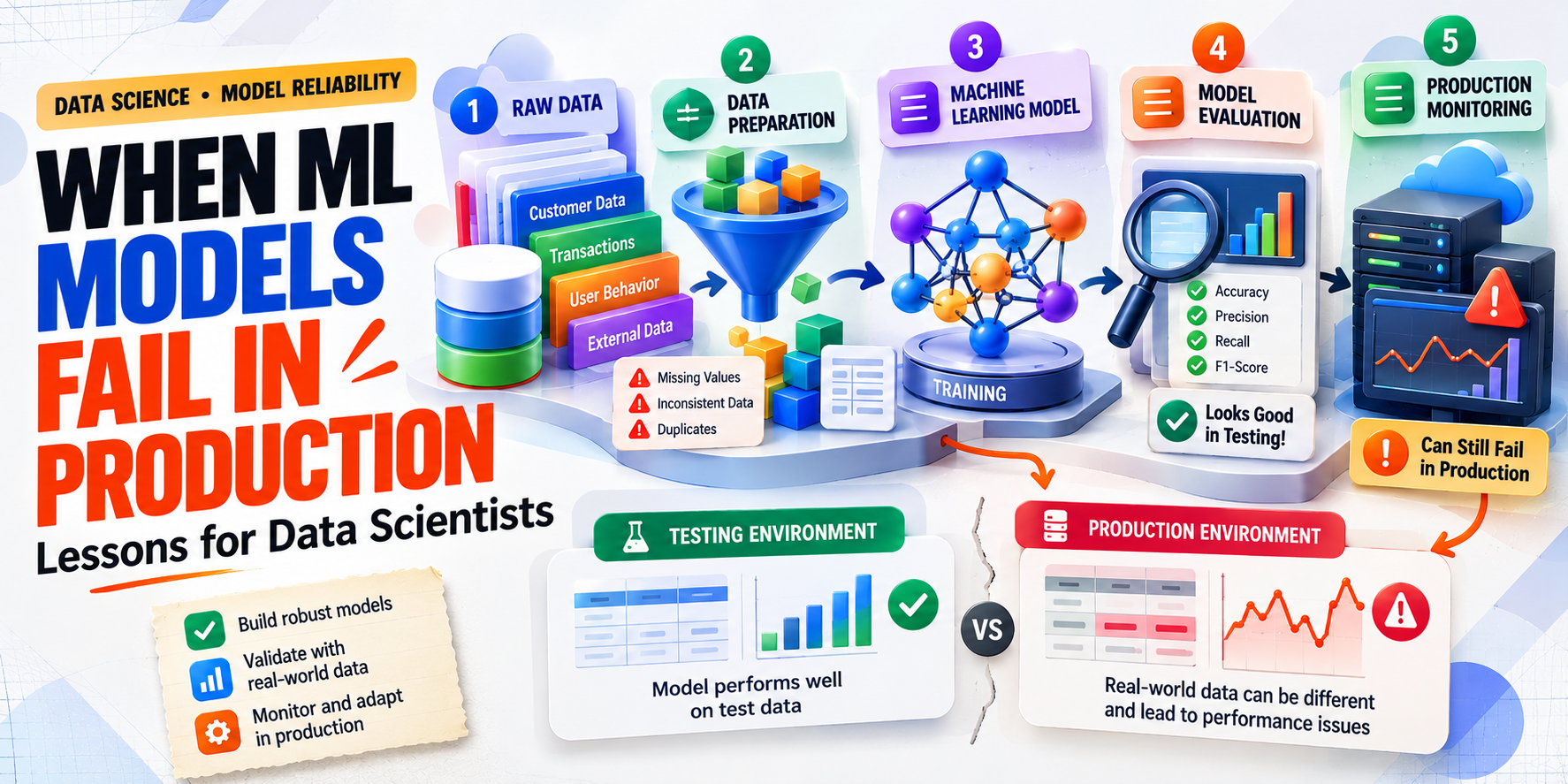
A Data Science Model Can Look Accurate and Still Be Wrong: How to Build More Reliable Predictions
Learn how data leakage, evaluation design, error analysis and monitoring affect the reliability of machine learning models.
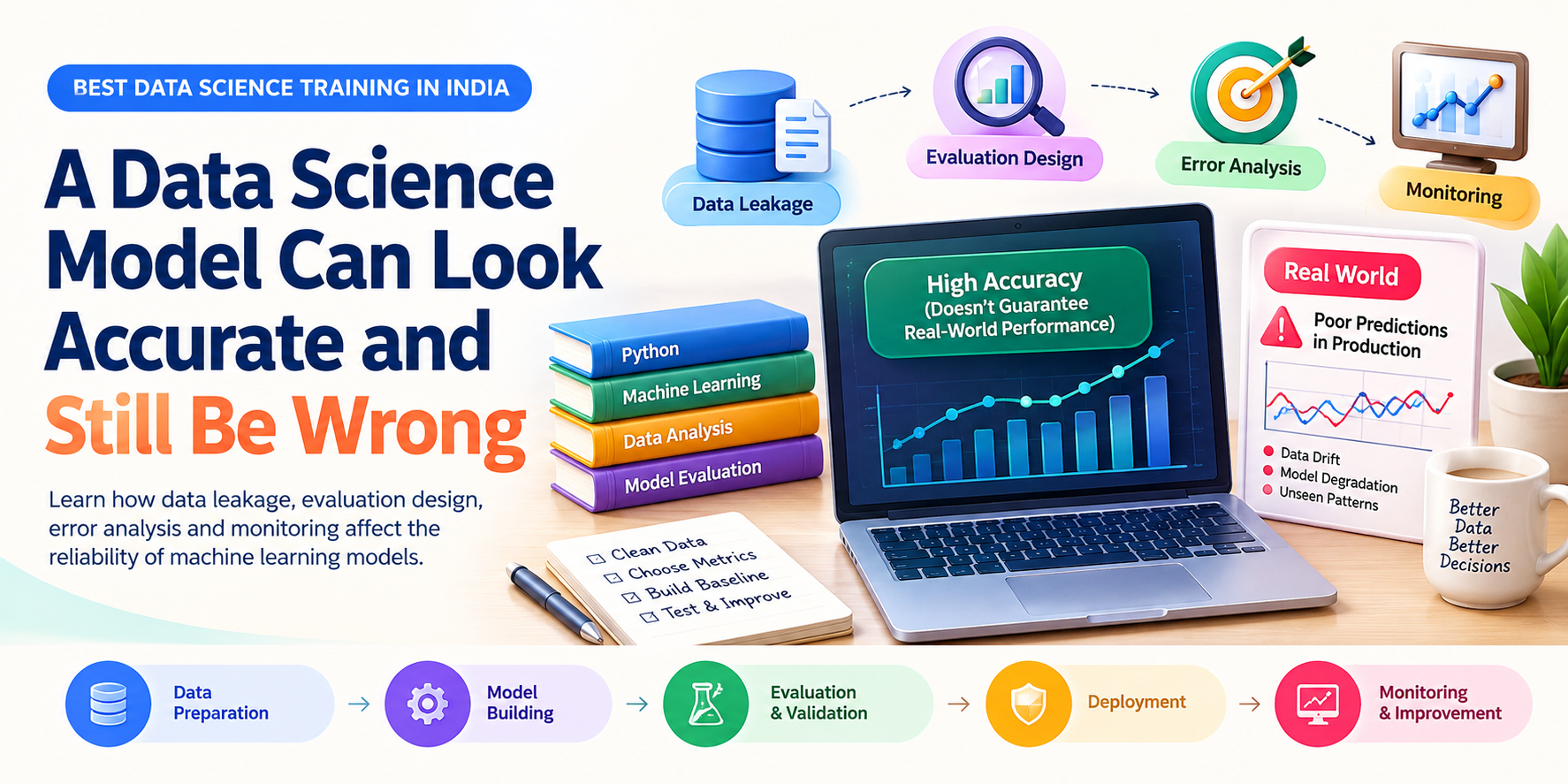
A machine learning model can achieve impressive results during testing and still make poor predictions when it encounters new data. This is one of the most important lessons in practical data science: a good-looking performance metric does not automatically mean a model is ready for real-world use.
Imagine building a model to predict which customers are likely to cancel a subscription. During evaluation, it reports high accuracy. However, after deployment, its predictions become unreliable because the training data contained information that would not have been available when the predictions were actually needed.
The issue is not necessarily the algorithm. It may be the way the data was prepared, how the evaluation was designed, or whether the test environment reflected the real problem.
For anyone learning data science, understanding these limitations is just as important as learning Python, statistics or machine learning libraries. Reliable data science involves asking the right questions, checking assumptions, designing valid experiments and communicating uncertainty.
Why Model Accuracy Does Not Tell the Whole Story
Accuracy measures the proportion of predictions a model gets correct. It can be useful, but it does not describe every type of prediction problem equally well.
Consider a fraud detection dataset in which only 1% of transactions are fraudulent. A model that predicts every transaction as legitimate could achieve 99% accuracy while failing to identify a single fraudulent transaction.
This example illustrates why evaluation must match the problem being solved.
Depending on the use case, a data scientist may need to examine:
- Precision: Of the cases predicted as positive, how many were actually positive?
- Recall: Of the actual positive cases, how many did the model identify?
- F1-score: How well does the model balance precision and recall?
- Confusion matrix: Which categories are being predicted correctly or incorrectly?
- Calibration: Do predicted probabilities correspond reasonably well to observed outcomes?
- Business impact: What are the practical costs of false positives, false negatives and correct predictions?
No single metric is best for every situation. A fraud detection system, a demand forecasting model and a medical risk prediction tool have different requirements and consequences.
The first responsibility of a data scientist is to understand the decision the model will support and select evaluation measures accordingly.
Data Leakage: A Hidden Threat to Machine Learning
Data leakage occurs when information that would not legitimately be available at prediction time influences model training or evaluation. It can make a model appear more capable than it really is.
There are several common ways leakage can happen.
Using Information From the Future
Suppose a company wants to predict whether a customer will cancel a subscription next month. If the input dataset includes a field created after cancellation, the model may learn from information that would not exist at the time of prediction.
The evaluation may look excellent because the model has effectively been given clues about the answer.
Splitting Related Records Incorrectly
A dataset may contain multiple records for the same customer, patient, device or organisation. If closely related records appear in both the training and test sets, the evaluation may overestimate how well the model generalizes to genuinely new cases.
The correct splitting strategy depends on the data and the intended deployment scenario. Group-based splitting may be necessary when records are related, while time-based splitting is often appropriate for forecasting future outcomes.
Preprocessing Before the Data Split
Operations such as feature selection, imputation and scaling can leak information when they are fitted using the full dataset before evaluation.
A safer approach is to fit preprocessing steps on the training data and apply the learned transformations to validation and test data. A properly configured machine learning pipeline helps maintain this separation.
These checks may seem less exciting than experimenting with complex algorithms, but they can make the difference between a trustworthy evaluation and a misleading result.
Design the Evaluation Around the Real Use Case
Before choosing a model, define how it will be used.
If the goal is to forecast next month's demand, randomly mixing past and future observations may not provide a realistic test. A time-based evaluation can better represent the challenge of predicting future values from historical information.
If the goal is to classify new customers, the test set should represent the kind of customers the model will encounter after deployment.
A practical evaluation process can follow these steps:
- Define the prediction target. Specify exactly what the model must predict and when that prediction will be made.
- Establish a baseline. Compare the proposed model with a simple rule or straightforward approach.
- Choose a suitable split. Consider time, customer groups, repeated observations and other dependencies.
- Build a reproducible pipeline. Keep preprocessing and model training consistent across experiments.
- Select meaningful metrics. Measure the types of errors that matter for the intended decision.
- Inspect failure cases. Examine where predictions are wrong and whether errors follow a particular pattern.
- Preserve an appropriate test set. Avoid repeatedly tuning decisions against the same final test results.
This process helps data scientists understand not just whether a model performs well, but under which conditions its performance can be trusted.
A Practical Project: Predicting Customer Churn
Customer churn prediction is a useful learning project because it combines business understanding, data preparation, classification and evaluation.
The objective is to estimate which customers may stop using a service within a defined period. The project should begin by clarifying what counts as churn and which information would be available at the prediction date.
Step 1: Understand the Data
Inspect the available fields, identify missing values, examine duplicate records and investigate the distribution of the target variable.
Look for suspicious columns that may indirectly reveal the outcome. For example, a cancellation confirmation field should not be used as an input when predicting cancellation before it happens.
Step 2: Establish a Baseline
Create a simple baseline before trying advanced models. This helps establish whether a more complex approach provides a meaningful improvement.
Document the baseline method and its limitations so that later results can be compared fairly.
Step 3: Train and Evaluate Models
Try an appropriate classification algorithm and evaluate it using metrics that reflect the business objective. If identifying at-risk customers is more important than avoiding every false alarm, recall may deserve particular attention. Precision should also be considered because unnecessary interventions can consume resources.
The right balance depends on how the company intends to use the predictions.
Step 4: Investigate Errors
Review false positives and false negatives. Are certain customer groups consistently misclassified? Are important variables missing? Is the model relying on unstable patterns?
These questions can lead to useful improvements in data collection, feature design or evaluation.
Step 5: Explain the Limitations
A model may identify patterns associated with churn without proving why customers leave. Predictive relationships should not automatically be interpreted as causal explanations.
A useful project report should document the data, assumptions, evaluation method, results and known limitations. Any claimed improvement should be supported by measured results rather than invented figures.
From Model Development to Production Monitoring
A model's work does not end when its evaluation is complete. Real-world data can change over time as customer behavior, market conditions, business processes or data collection methods evolve.
Monitoring helps teams identify when a model's inputs or predictions begin to behave differently from expectations.
Depending on the application, useful checks may include input-data quality, changes in feature distributions, prediction patterns, system failures and model performance when reliable outcome labels become available.
Not every change means a model has failed. A shift in the data should trigger investigation rather than an automatic assumption that retraining will solve the problem.
Teams should also define who is responsible for reviewing issues, when a model should be updated and how changes will be validated before deployment.
This connects data science with software engineering, business operations and ongoing risk management.
How to Choose Data Science Training That Builds Practical Skills
When evaluating a learning program, look beyond the number of algorithms or tools listed in the syllabus. The quality of the learning process matters because data science requires reasoning, experimentation and the ability to explain results.
Look for a curriculum that includes statistics, data cleaning, exploratory data analysis, feature engineering, model evaluation and practical machine learning workflows. Depending on your goals, Python, SQL, data visualization and deployment concepts may also be important.
Projects should require more than running a notebook and reporting a score. Ideally, learners should define a problem, examine data quality, establish a baseline, select evaluation metrics, investigate errors and document limitations.
It is also worth checking whether the course explains prerequisites, project expectations, assessment methods and the type of certificate awarded. A course completion certificate and an external professional certification should not be assumed to be equivalent.
If you are comparing programs, review the Best Data Science Training in India course page and assess the available details against your current skills and learning objectives.
The most suitable program is the one that helps you build demonstrable skills for your intended career path, rather than simply promising familiarity with a long list of technologies.
What a Strong Data Science Portfolio Should Show
A portfolio is more useful when it explains the thinking behind a result, not just the final chart or model score.
For each project, include the business or research question, the source and limitations of the data, the preprocessing decisions, the evaluation strategy and the reasoning behind the selected metrics.
Show how the model compares with a baseline, describe the errors it makes and explain what additional information could improve the solution. If the project includes deployment or monitoring, document how you would detect and respond to changes in performance.
Be transparent about what you personally built and what remains incomplete. A carefully explained project with realistic limitations can demonstrate stronger analytical judgement than an impressive metric without supporting evidence.
Frequently Asked Questions
Is high accuracy enough to prove that a machine learning model is good?
No. Accuracy may hide poor performance on minority classes or costly types of errors. The appropriate evaluation measures depend on the problem, data distribution and intended use.
What is data leakage in machine learning?
Data leakage occurs when information that should not be available to the model during training or prediction influences the learning process or evaluation. It can produce misleading performance estimates.
Why is a baseline important in data science?
A baseline provides a simple point of comparison. It helps determine whether a more complex model offers a meaningful improvement over a straightforward approach.
Should a model be monitored after deployment?
Yes, when the application requires ongoing reliability. Monitoring can help teams detect changes in input data, system behavior or measured performance and investigate whether corrective action is needed.
What should beginners prioritize when learning data science?
Start with Python or another suitable analytical tool, basic statistics, data preparation, exploratory analysis and clear problem definition. Then practice building and evaluating models with realistic datasets and documented assumptions.
Conclusion
Reliable data science is not about producing the highest possible metric at any cost. It is about building models whose performance has been evaluated honestly, whose limitations are understood and whose outputs are appropriate for the decisions they support.
Learning to identify data leakage, choose valid evaluation strategies, investigate errors and monitor deployed systems creates a stronger foundation for practical machine learning work.
Whether you are starting your data science journey or improving existing skills, focus on asking better questions, testing assumptions and explaining evidence clearly. Those habits make your projects more credible and your modelling decisions more defensible.
Comments
Join the discussionNo comments yet. Be the first to comment.