A Model That Works in Testing Can Still Fail in Production: Lessons for Data Scientists
A Model That Works in Testing Can Still Fail in Production: Lessons for Data Scientists
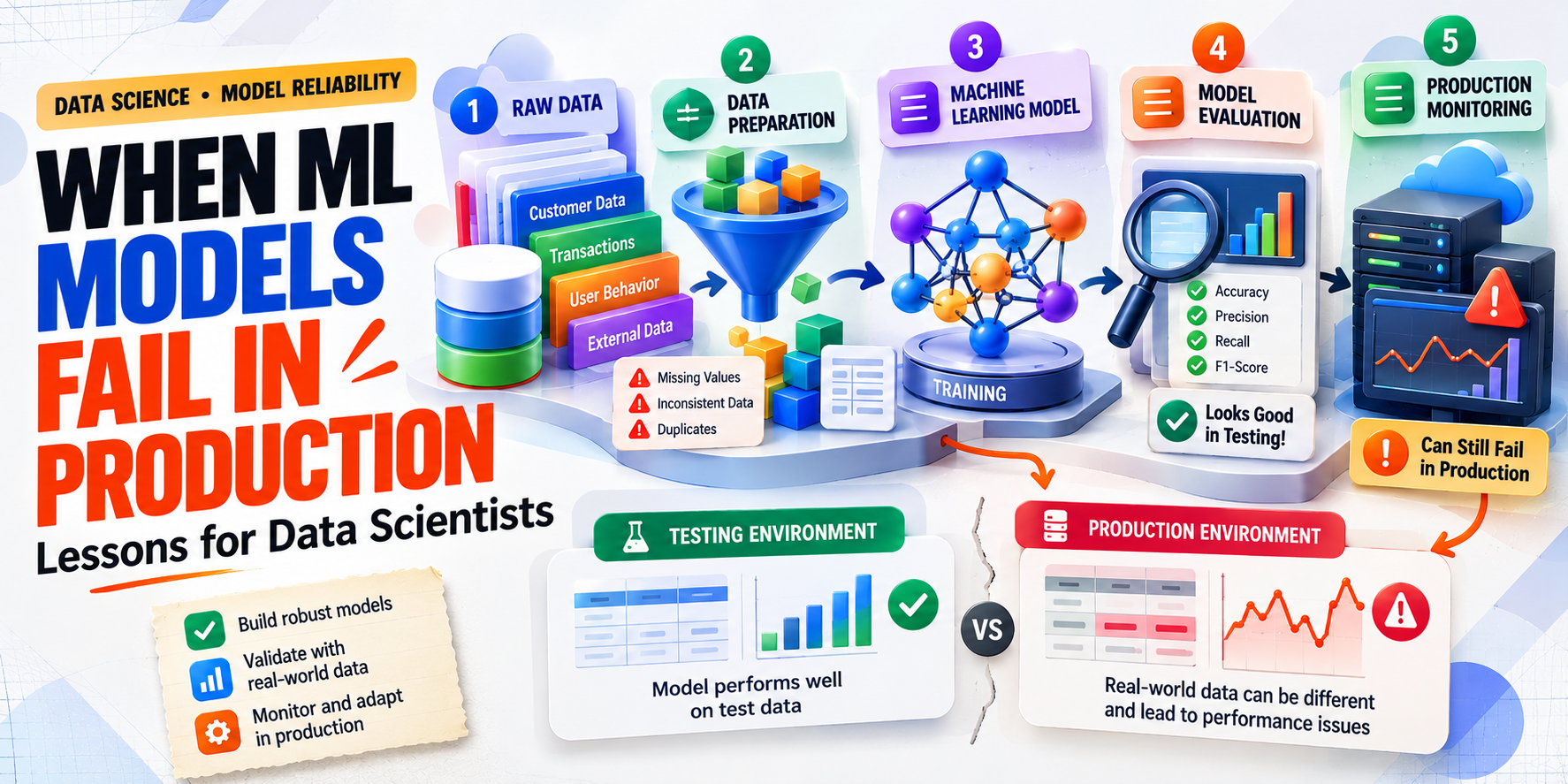
A machine learning model can achieve an impressive score during experimentation and still deliver disappointing results when used in a real application.
A model might perform well on a test dataset but struggle with new customer behavior. A prediction pipeline might work on a developer's machine but fail when production data contains unexpected values. A model may even appear accurate because information from the future accidentally entered the training process.
These problems reveal an important distinction in data science: building a model is not the same as building a reliable predictive system.
For aspiring data scientists, understanding data quality, evaluation, reproducibility and deployment is just as important as learning machine learning algorithms. These skills help connect experimentation with practical problem-solving.
Why Good Test Scores Can Be Misleading
Model evaluation is necessary, but the quality of the evaluation process determines how meaningful the results are.
Consider a customer churn model designed to identify customers who may cancel a subscription. Suppose the dataset contains information collected after cancellation, such as a final account status or a closure reason. If these fields are accidentally included as predictors, the model may achieve excellent test performance.
However, those signals would not be available when the business actually needs to identify customers at risk of leaving.
This is an example of data leakage: information that would not legitimately be available at prediction time influences the model or its evaluation.
Leakage can occur through feature engineering, preprocessing, target construction, duplicate records or an inappropriate data-splitting strategy.
A reliable workflow must therefore ask not only whether a feature improves model performance, but also whether that feature would genuinely be available when the prediction is made.
Start With the Data-Generation Process
Before choosing an algorithm, understand how the data was collected and what each record represents.
For example, an e-commerce dataset might contain one row per order, one row per product within an order, or one row per customer. These structures are not interchangeable.
If an analyst assumes that each row represents a unique order when several rows actually represent individual products, revenue calculations and customer-level features may become incorrect.
Useful checks include:
Understanding the meaning of each column
Identifying unique keys and duplicate records
Examining missing values and unusual ranges
Checking timestamps and reporting periods
Investigating changes in data collection
Confirming how the target variable was defined
Domain knowledge matters here. A negative transaction value may be an error, a refund or a legitimate accounting adjustment. The correct interpretation depends on the business process.
Data cleaning should not be a mechanical exercise in deleting unusual values. It should be a documented process based on evidence and appropriate assumptions.
Build an Evaluation Strategy That Matches Reality
A model's evaluation method should reflect how it will be used.
For a dataset of independent observations, a train-validation-test split may be appropriate. But if observations are related by customer, location or time, a random split can create an unrealistic evaluation.
Time-Dependent Predictions
For forecasting or predicting future events, training on earlier periods and testing on later periods is often more representative than randomly distributing records across the datasets.
Repeated Customers or Entities
If multiple records belong to the same customer, the split may need to keep that customer's records together. Otherwise, the model could learn customer-specific patterns from training data and appear to generalize better than it actually does.
Imbalanced Classification
In fraud detection or rare-event prediction, accuracy alone can be misleading. A model that predicts the majority class every time may achieve high accuracy while failing to identify the events that matter.
Depending on the problem, useful metrics may include precision, recall, F1 score, ROC-AUC, PR-AUC, calibration and business-specific cost measures.
There is no universally best metric. The right choice depends on the consequences of false positives and false negatives, the prevalence of the target event and the decisions that will follow the prediction.
Prevent Leakage During Preprocessing
Preprocessing is often necessary for machine learning, but its implementation can introduce subtle errors.
Consider a workflow that standardizes numerical features using their mean and standard deviation. If those statistics are calculated using the entire dataset before splitting it, information from the test set influences the training process.
The safer approach is to fit preprocessing steps using the training data and then apply the learned transformations to validation, test and future data.
The same principle applies to operations such as imputation, feature selection and dimensionality reduction.
Using a properly constructed pipeline can help keep preprocessing consistent and reduce accidental leakage. It also makes the workflow easier to reproduce.
Reproducibility Is Part of Model Quality
A data science project should not depend on a sequence of undocumented notebook executions.
If another developer cannot understand how the dataset was prepared, which features were selected, how the model was trained or how the reported metric was calculated, it becomes difficult to verify the result.
A more maintainable workflow should record:
Data sources and versions
Cleaning and feature-engineering decisions
Training and evaluation procedures
Model parameters and configuration
Dependency versions
Evaluation results
Known limitations
Tools such as Git, structured project directories, Python environments and automated pipelines can support reproducibility.
For larger projects, experiment tracking and model registries can help teams compare model versions and understand which artifact was evaluated or deployed.
The objective is not to introduce unnecessary infrastructure into every small project. It is to make the workflow sufficiently transparent for its intended use.
From a Notebook to a Production Prediction
A notebook can demonstrate that a model is possible. A production system must also handle inputs, failures and changes over time.
Imagine a model that predicts delivery delays. During experimentation, the dataset contains clean numerical fields and complete timestamps. In production, a new data feed may introduce missing values, unfamiliar categories or a changed date format.
Without input validation and monitoring, the application could return incorrect predictions or fail unexpectedly.
A practical deployment workflow should consider:
Input validation: Check required fields, types and acceptable ranges.
Consistent preprocessing: Apply the same transformations used during model development.
Model serving: Provide a controlled interface for generating predictions.
Logging: Record relevant operational information without exposing unnecessary sensitive data.
Monitoring: Track errors, latency, input changes and, when ground-truth outcomes become available, model performance.
Retraining decisions: Reassess the model when evidence shows that its performance or assumptions are no longer suitable.
Monitoring input drift does not automatically prove that model quality has deteriorated. It is a signal to investigate, especially when combined with delayed labels, business outcomes or changes in the data-generation process.
A Practical Project: Predicting Customer Churn Responsibly
A customer churn project can demonstrate the complete data science lifecycle.
Begin by defining the prediction target and the moment at which the prediction will be made. Establish which features would be available at that moment.
Next, inspect the dataset for duplicates, missing values, leakage risks and differences between customer groups. Choose a split strategy that reflects how predictions will be used. If the objective is to predict future churn, a time-aware evaluation may be more appropriate.
Train a simple baseline model before experimenting with more complex algorithms. Compare results using metrics that reflect the business cost of missed churners and unnecessary interventions.
Then document the model's limitations. For example, customer behavior may change after a pricing update, or the training data may not represent newly acquired customers.
A strong project deliverable includes the methodology, validation results, metric definitions, reproducible code and a clear explanation of what the model can and cannot establish.
This is more informative than presenting a high accuracy score without explaining how it was obtained.
How to Develop Job-Relevant Data Science Skills
For learners exploring Data Science training in India, a useful learning path should cover the full process from data preparation to model evaluation.
When comparing programs, examine whether they provide practical experience with:
Python and data manipulation
SQL and data retrieval
Statistics and probability
Exploratory data analysis
Feature engineering
Machine learning algorithms
Model validation and leakage prevention
Appropriate evaluation metrics
Reproducible project workflows
Deployment and monitoring fundamentals
Projects should also require learners to explain their decisions. Why was a particular metric selected? Why was a time-based split used? What happens when an input is missing? What evidence supports the final conclusion?
These questions help distinguish practical understanding from simply following a tutorial.
You can review Data Science Certification Training in India as one option when comparing curricula and project coverage. Check the current syllabus against your existing skills and learning objectives before deciding whether it is the right fit.
What to Include in a Data Science Portfolio
A portfolio should make the reasoning behind a project visible.
For each project, explain the problem, the dataset, the assumptions, the preprocessing strategy, the evaluation method and the results. Include a baseline for comparison and discuss limitations rather than reporting only the strongest metric.
Where possible, provide reproducible code, clear setup instructions and a short explanation of how the model could be used in a real workflow.
Do not claim that a model is production-ready simply because it performs well in a notebook. Production readiness also depends on operational requirements, security, monitoring, integration and the consequences of incorrect predictions.
This level of transparency helps reviewers assess not just coding ability, but also analytical judgment.
Frequently Asked Questions
Why can a machine learning model fail in production?
A model may encounter changing data, unexpected inputs, inconsistent preprocessing, distribution shifts or operating conditions that were not represented during evaluation.
What is data leakage in machine learning?
Data leakage occurs when information that should not be available to the model during training or evaluation influences its predictions or reported performance.
Is accuracy enough to evaluate a model?
Not always. For imbalanced or high-impact problems, precision, recall, F1 score, PR-AUC, calibration or business-specific metrics may be more informative.
Why is reproducibility important in data science?
Reproducibility makes it easier to verify results, compare experiments, collaborate with other developers and investigate changes in model behavior.
Should every data science project be deployed?
Not necessarily. Deployment depends on the project's purpose. However, understanding the requirements of deployment and monitoring helps learners recognize the difference between an experiment and an operational system.
What should learners look for in Data Science training in India?
Review the curriculum, practical assignments, evaluation methods, project quality, instructor support and coverage of data preparation, machine learning, reproducibility and deployment fundamentals.
Conclusion
Reliable data science requires more than choosing an algorithm and maximizing a test score. It depends on understanding the data, preventing leakage, selecting an appropriate evaluation strategy, documenting experiments and planning for real-world inputs.
For aspiring data scientists, these practices create a stronger foundation for building predictive systems that can be reviewed, reproduced and improved.
The most valuable project is not necessarily the one with the highest reported accuracy. It is the one where the methodology is clear, the evaluation is credible and the limitations are understood.
Comments
Join the discussionNo comments yet. Be the first to comment.